Tuesday, 10:42. Mrs Jansen calls about her quote. You answer. Mark made the quote and is in a meeting until half past eleven. “Mark will call you back before two,” you say. You pass it on to Mark, with a short note.
At 11:31 Mark sees the request. He also sees her message from yesterday. He calls back from the business number. She answers straight away.
Only his coffee has gone cold by now.
In short: a callback request is a note for a colleague to call a customer back. Write down who called, on which number, why and what you promised. Give the request to one colleague. They call back from the business number, so the customer recognises the number.
A customer calls. The colleague who can help them is not available. You note that the customer wants to be called back and pass it on. That is a callback request. You also hear it called a phone message or callback note.
With a missed call, nobody answered. With a callback request, someone did answer. So the customer has already heard a voice and been given a promise.
Five things. Nothing more is needed.
An example:
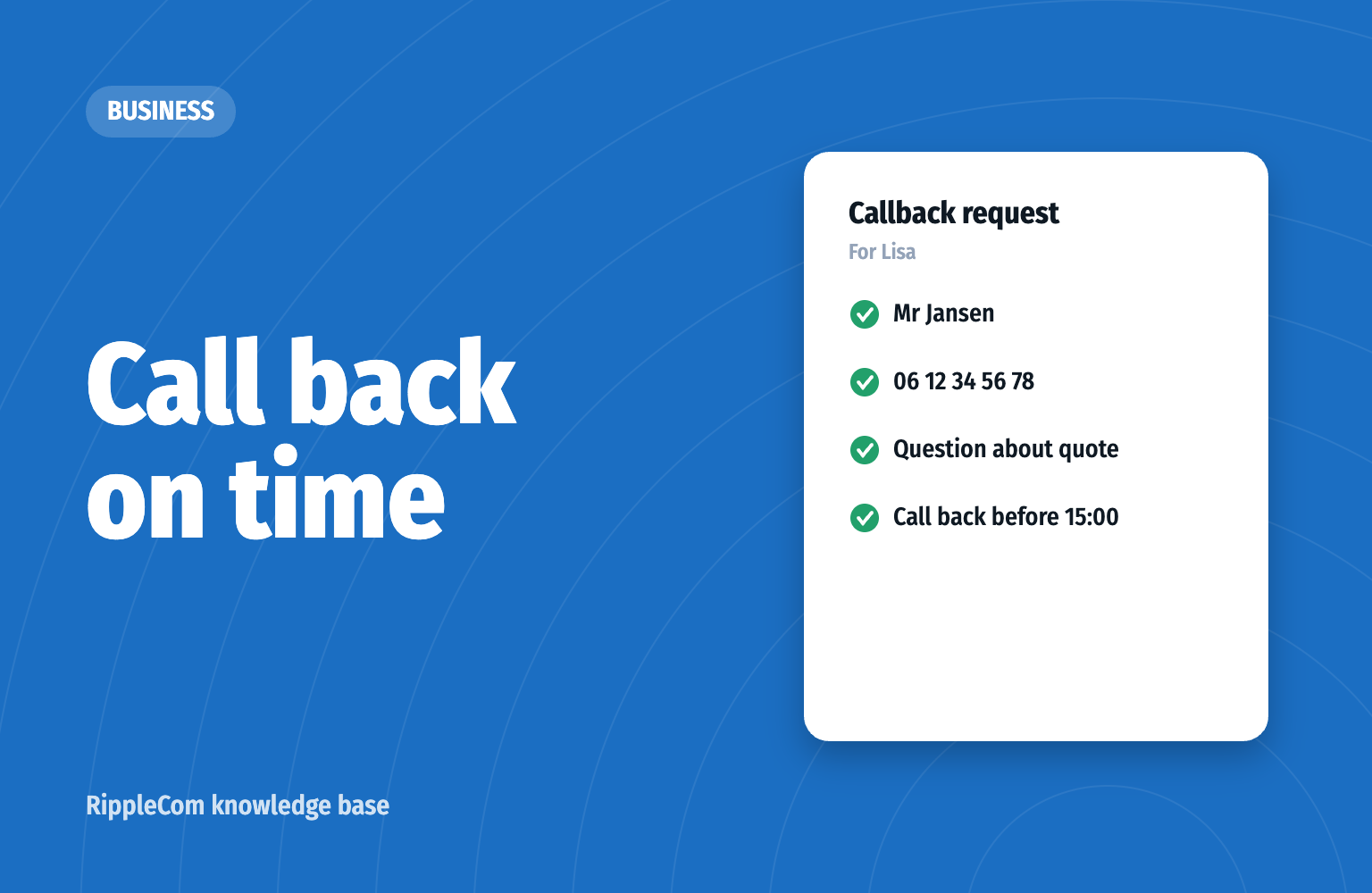
Mrs Jansen, on her mobile. Question about quote 114: can the delivery be a week earlier? Promised: called back before 14:00. Not available after 15:00.
Do not write down more than you need to call back. That is also the rule under the GDPR. You may not process more personal data than you need for your purpose (Dutch Data Protection Authority). Is it about something sensitive, such as health? Then just write: question about her file.
Say who will call them back and when. “Mark will call you back before two.” Then the customer knows where they stand.
Only promise what you can deliver. Don’t know when Mark is free? Then say: “You will be called back today.”
Check that the number is right. Is the customer calling from work and will they be at home later? Then they may want to be called on another number.
Give every callback request one name. Then everyone knows who is doing it.
Can that colleague not manage it in time? Then they pass the request on to someone else. With the note. So the customer does not have to tell their story again.
Is your colleague calling back from their own mobile number? Then the customer does not know that number. An iPhone can silence calls from unknown numbers and send them to voicemail. That setting is called Silence. An iPhone can also ask an unknown caller why they are calling, before the phone even rings (Apple).
So call back from the business number. That is the number the customer called themselves. Does their phone ask why you are calling? Say your name, the company and that they asked to be called back.
At RippleCom, calls, WhatsApp and SMS come in on your company’s number. You answer and your colleague is not available? Then you pass the conversation on to them, with a note. That is your callback request.
The request reaches your colleague in one overview. They see your note, the customer’s messages and who called them before. They call back from the business number. The number the customer called themselves.
Read more about calling on your own business number and about a phone system with WhatsApp.
A note for a colleague to call a customer back. The customer called, the right colleague was not available and someone else answered. You also hear it called a phone message or callback note.
The customer’s name, the number they want to be called on, why they called, what you promised and when they are not available. Nothing more is needed.
With a missed call, nobody answered. With a callback request, a colleague answered and passed it on. The customer has then already been given a promise.
As quickly as you promised the customer. When you answer, name a time your colleague can keep to. Then stick to it.
You may be calling from a number they don’t know. An iPhone can silence such calls and send them to voicemail. So call back from the business number the customer called themselves.
Yes, as far as you need it to call back. Name, number and the reason in one sentence. Under the GDPR you may not process more data than you need for your purpose.
You pass the conversation on to your colleague, with a note. They see the request in one overview, with the customer’s messages and earlier calls. They call back from the business number.
Free Communication Scan
Take the free Communication Scan. 6 questions, 1 minute, your result straight to WhatsApp.
or book a 30 minute demo

We are directly and easily accessible to our customers. Our team works optimally together with RippleCom. We can help more customers with our current team, and we have saved two FTEs.


Thousands of customers. One communication standard. No missed messages. Linked with OutSmart. One inbox. Always an answer. Always traceable. RippleCom is our central control for customer contact.
This is how retail works in 2026


Customers called us 3,500 times a month about parts. Now they WhatsApp their registration and a photo of the type plate. An answer within twenty minutes. Connected to our phone system. 75% fewer calls. And messages arrive.


Reachable for my clients. Peace of mind for me. I get everything clearly organised in my email inbox. 90% of the most frequently asked question, “Can I have extra money?”, arrives separately. Either I pick it up or my colleagues do. With RippleCom I have peace and overview.

Involving residents in sustainability requires trust. That starts with accessibility. With RippleCom, we have managed to reach 20% of the residents. Fully transparent. This is how you build support.


We are active in eleven countries and serve thousands of customers. Hundreds of conversations a day. Without central control, that would be impossible. 300% higher customer satisfaction and conversion on price calculations from 4% to 37%. RippleCom scales with us.


Orthodontics is all about planning. Every appointment counts. With RippleCom, we have control over every patient contact. Reminders and changes are linked with our system. From 47 down to 12 no-shows per month. Our schedule is accurate. Our patients attend.


Our customers expect service at the highest level. That begins with communication. Direct. Personal. Reliable. Every appointment is confirmed. Every question answered. One inbox. Always an answer. That is what premium feels like.