In short: Article 32 GDPR asks for security that matches the risk. It contains no list of products. For a healthcare provider, the biggest risk is rarely the record itself. It lies in the moment data leaves the practice: a result sent by email, a referral letter as an attachment, a message to the wrong recipient. Get that moment right and you reduce the chance of a data breach and can show the regulator why your measures fit.
Friday, 16:40. The assistant emails a discharge letter to Mr De Vries. The address fills itself in. It is the wrong De Vries. Nobody was hacked. Still, a medical letter is now with a stranger.
Everyone wants to be heard.
That includes their data. A patient trusts that their letter reaches only them.
Article 32 GDPR requires healthcare providers to take technical and organisational measures that match the risk to patients. On top of that, the Dutch Decree on electronic data processing by healthcare providers (Besluit elektronische gegevensverwerking door zorgaanbieders) requires you to work according to NEN 7510, NEN 7512 and NEN 7513. The weak spot is usually not the record. It is the exchange: email, attachments and messages to patients. That is where things go wrong most often in practice. Turn that exchange into a fixed, secure route. A mistake then becomes something you can fix instead of a data breach you cannot undo.
The article asks for “a level of security appropriate to the risk”. It does not say which product to use. You look at the state of the art, the costs, the nature of the processing and the harm a patient could suffer if things go wrong.
The article does give examples of measures:
Health data is a special category of personal data. The risk to the patient is therefore high and so is the bar. Write down why your measures fit. That is part of your duty to be able to demonstrate that you comply with the GDPR.
For Dutch healthcare providers, a decree comes on top of the GDPR. The Decree on electronic data processing by healthcare providers requires you to work according to NEN 7510 and NEN 7512 and to set up logging according to NEN 7513. NEN 7510 covers information security in healthcare. NEN 7512 covers secure data exchange between parties. NEN 7513 covers recording actions in electronic patient records, such as who viewed a record.
Do you use email for health information? Then NTA 7516 also applies. This Dutch standard for secure email in healthcare was published in 2019.
Most security sits around the patient record. The risk grows as soon as data leaves that system. Think of a referral letter by email, a photo of a medication list that a patient sends to the general email address or a result that stays in a mailbox as an attachment.
The figures show where it goes wrong. In the first half of 2024, the Dutch Data Protection Authority received more than 9,800 data breach notifications. In 41 percent of cases it involved a letter or parcel, for example delivered to the wrong recipient. In 18 percent it involved an email containing personal data. Half of all notifications came from public administration and healthcare.
So it is rarely about a hacker. It is about ordinary routine: an address that fills itself in, the wrong attachment, a letter in the wrong envelope.
Good intentions are not enough. The route itself has to enforce it. These six measures help:
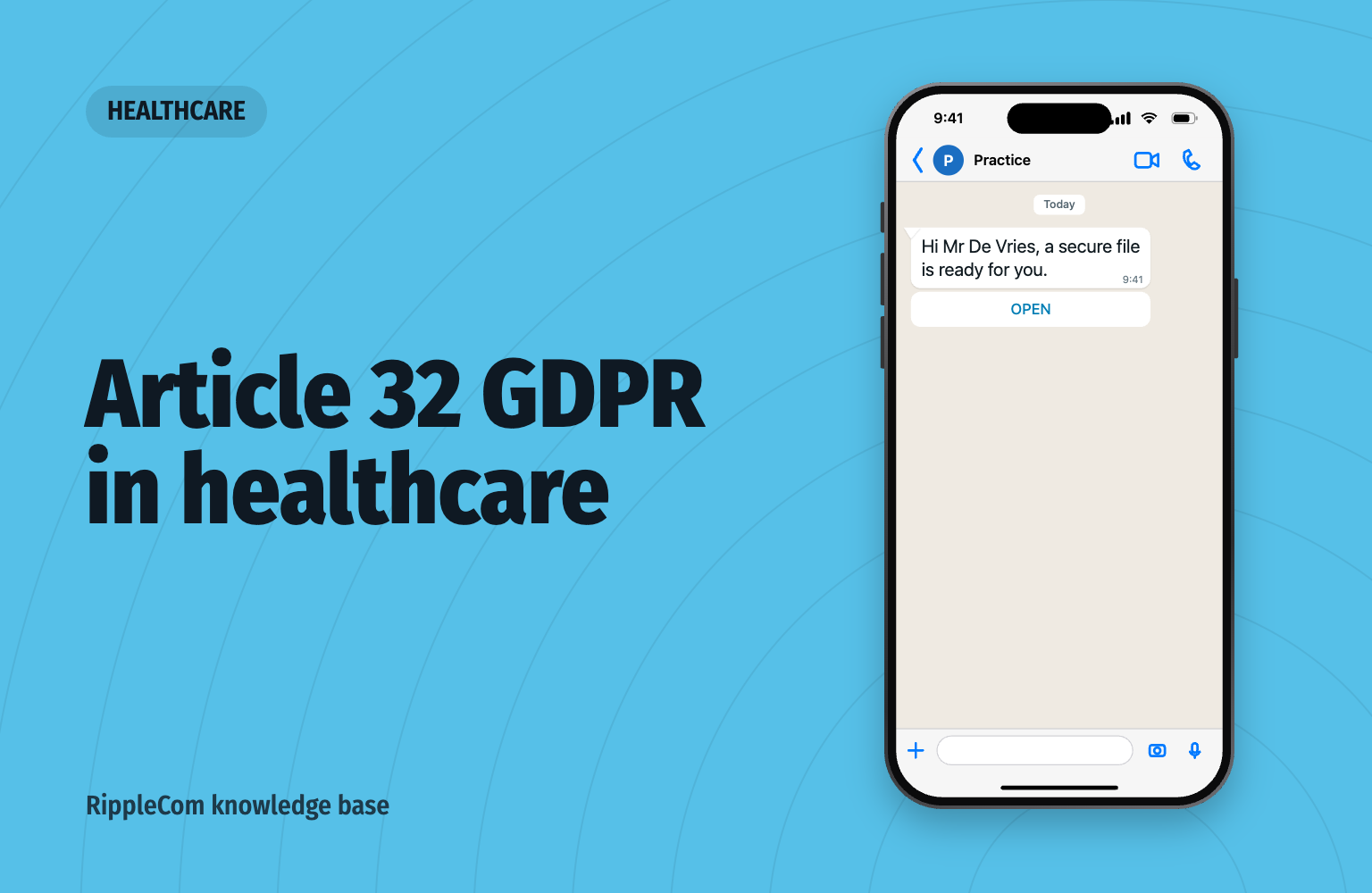
With Secure Transfer you exchange confidential files and short notes with patients via WhatsApp, on the practice’s business number. The communication goes via WhatsApp. The sensitive information goes via Dutch servers.
The patient receives one message from the practice with an OPEN button. They request a six-digit code. It arrives on their own number. With that code they open the file on their phone. They do not need an account or an app.
Your browser encrypts the file before it leaves your computer. It only becomes readable again on the patient’s device. The key to open it travels in the link in the message. RippleCom does not store that key. The document itself does not travel over Meta’s network.
Files are kept for 14 days by default and notes for 30 days. After that they are deleted. You can see whether a delivery has been sent or opened and you can withdraw it straight away. Staff work in their own environment with a separate login and always a second sign-in step. Through a fixed link, the patient can also send documents back to you securely.
This way the route fits what Article 32 mentions: encryption and limited access. Deleting after a set period fits the GDPR rule not to keep data longer than necessary. Which measures are appropriate for your organisation is something you record in your own risk assessment.
Friday, 16:40. The assistant selects the discharge letter and Mr De Vries’s number. He receives a message from the practice. Only his number gets the code. So it lands.
Appropriate technical and organisational measures to protect patient data. What is appropriate depends on the risk. With health data, that risk is high. You record why your measures fit.
Article 32 mentions encryption as an example of an appropriate measure. It is not a separate obligation. For medical documents that leave the practice, encryption is the obvious choice.
The Decree on electronic data processing by healthcare providers requires you to work according to NEN 7510, NEN 7512 and NEN 7513. NEN 7513 covers recording actions in electronic patient records. For email containing health information there is NTA 7516.
Then there is a data breach. Report it to the Dutch Data Protection Authority no later than 72 hours after you discover it, unless it is unlikely to result in a risk to the patient. Record every data breach in your own register, even if you do not report it.
Free Communication Scan
Take the free Communication Scan. 6 questions, 1 minute, your result straight to WhatsApp.
or book a 30 minute demo

We are directly and easily accessible to our customers. Our team works optimally together with RippleCom. We can help more customers with our current team, and we have saved two FTEs.


Thousands of customers. One communication standard. No missed messages. Linked with OutSmart. One inbox. Always an answer. Always traceable. RippleCom is our central control for customer contact.
This is how retail works in 2026


Customers called us 3,500 times a month about parts. Now they WhatsApp their registration and a photo of the type plate. An answer within twenty minutes. Connected to our phone system. 75% fewer calls. And messages arrive.


Reachable for my clients. Peace of mind for me. I get everything clearly organised in my email inbox. 90% of the most frequently asked question, “Can I have extra money?”, arrives separately. Either I pick it up or my colleagues do. With RippleCom I have peace and overview.

Involving residents in sustainability requires trust. That starts with accessibility. With RippleCom, we have managed to reach 20% of the residents. Fully transparent. This is how you build support.


We are active in eleven countries and serve thousands of customers. Hundreds of conversations a day. Without central control, that would be impossible. 300% higher customer satisfaction and conversion on price calculations from 4% to 37%. RippleCom scales with us.


Orthodontics is all about planning. Every appointment counts. With RippleCom, we have control over every patient contact. Reminders and changes are linked with our system. From 47 down to 12 no-shows per month. Our schedule is accurate. Our patients attend.

Our customers expect service at the highest level. That begins with communication. Direct. Personal. Reliable. Every appointment is confirmed. Every question answered. One inbox. Always an answer. That is what premium feels like.